Top












 Engineering for Robotic Pick & Place Cells
Pick & Place Cells Designed for Industrial Stability
At RCE, we design robotic cells as systems for controlling handling behavior under real-world variation. In Pick & Place systems, performance is not determined by the robot alone, but by how the entire system behaves when product characteristics, positioning, and flow vary. The real challenge is controlling the interactions between mechanics, vision, timing, and part feeding.
- Variation-driven instability
- Deviation propagation through the system
- Unpredictable operational behavior
- Uncontrolled complexity


Controlled system behavior
We control how variation enters the system and how it propagates through it, keeping operations stable and predictable.
Adaptation without performance loss
Our systems remain stable and predictable as products, production volumes, and cycle rates change.
Vision–Motion interaction

Vision data is not simply information; it becomes an input to the motion-control system. Variations in part position, orientation, or image quality introduce uncertainty into the motion command. If this variation is not accounted for in the system architecture, the motion system may continuously compensate for changing inputs, reducing cycle consistency and increasing sensitivity to disturbances.
Position variation and timing synchronization

When spatial variation becomes a timing problem: in Pick & Place systems, precision is both spatial and temporal. Changes in pickup or placement position can affect motion profiles, cycle timing, and synchronization with other processes. Small deviations can therefore propagate through the operating cycle and reduce execution consistency.
Automated feeding systems for assembly lines

Feeding flow and cycle time: when the input flow shapes system behavior, the feeding process cannot be treated as a passive condition. Variations in part availability, spacing, orientation, or arrival rate directly affect cycle dynamics, leading to cycle-time instability and variations in the overall behavior of the cell.
Handling sensitive or fragile parts
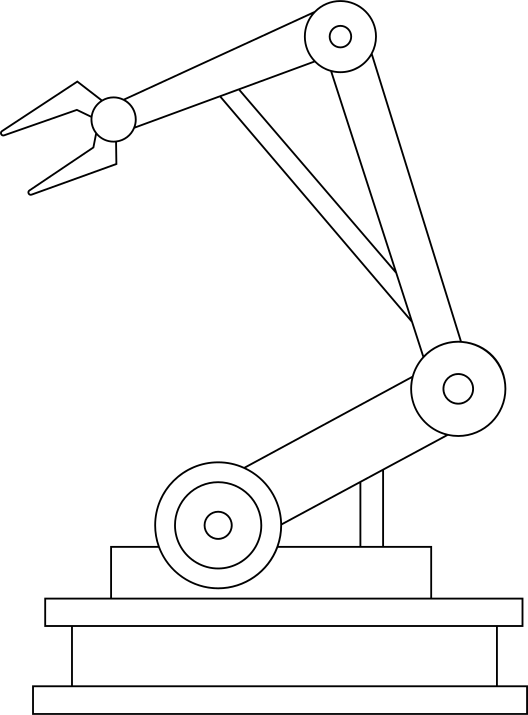
For fragile components, instability can result in more than retries — it can result in scrap. We control the mechanics of pickup and placement, stabilize contact conditions, and design clear handling sequences to reduce shocks, uncontrolled movement, and positional variation.
Transfers between processes with different cycle rates

When a robot connects two processes with different dynamics, an unstable architecture can lead to blocking or uncontrolled accumulation. We design defined interfaces and synchronization mechanisms that keep the system under control, even when process timing varies temporarily.
Applications with high upstream variation

When parts arrive from variable upstream processes — manual loading, bulk feeding, or inconsistent transport — variation is already present at the cell input. Instead of compensating for this variation with increasingly complex control logic, we manage it through physical stabilization, pre-positioning, controlled feeding, and clearly defined operating conditions.
Handling parts with variable tolerances
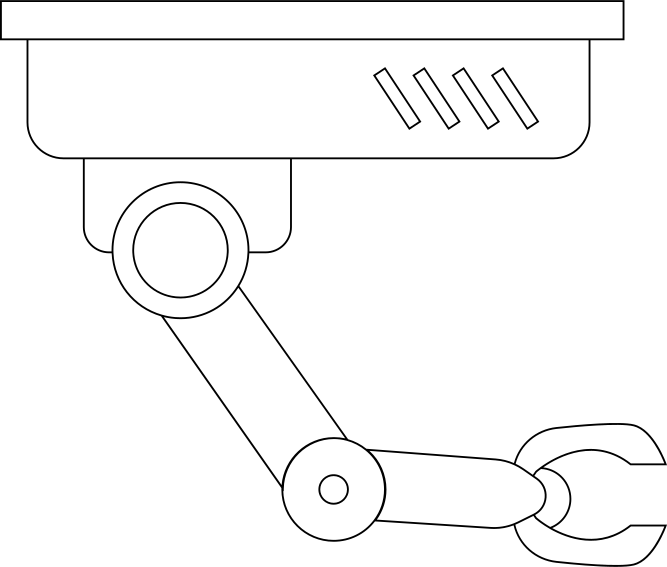
When part position, geometry, or orientation cannot be perfectly controlled, traditional systems often compensate with retries and additional corrections.
Through mechanical stabilization, deterministic behavior modeling, and clearly defined interfaces between subsystems, we reduce the need for software-based compensation and improve cycle repeatability.
Integration with vision systems
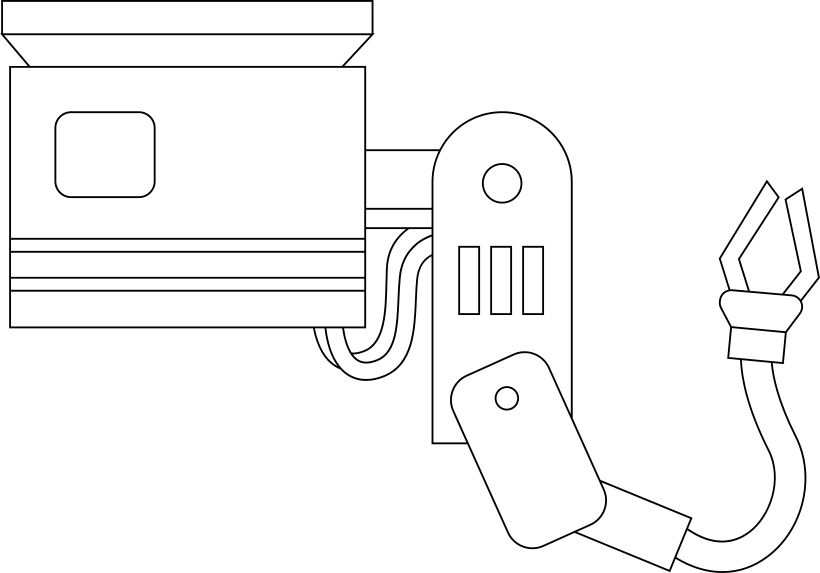
Vision-guided applications introduce additional sources of variation through latency, positional uncertainty, and successive corrections.
We design the architecture so that vision is an integrated part of the cell's behavioral model, not a reactive correction layer.
The result: fewer corrective loops and a more stable production cycle.
Automated part feeding for assembly lines

When a robot feeds downstream processes that are sensitive to timing, cycle-time variations can propagate through the entire flow. Variation control and deterministic state synchronization reduce these ripple effects and maintain predictable line performance.
Handling sensitive or fragile parts
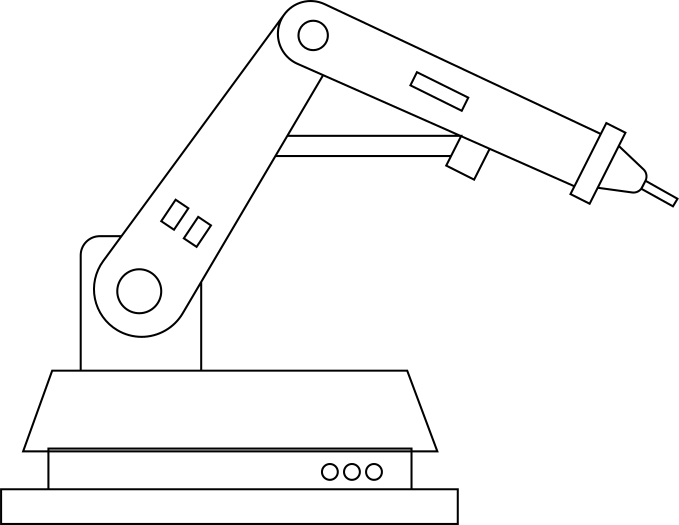
For fragile components, instability can result in more than retries — it can result in scrap. We control the mechanics of pickup, stabilize contact conditions, and define clear handling sequences to reduce shocks, micro-movements, and uncontrolled variation.
Transfers between processes with different cycle rates

When a robot connects two processes with different dynamics, an unstable architecture can lead to blocking or uncontrolled accumulation. We design defined interfaces and synchronization mechanisms that keep the system under control, even when process timing temporarily varies.
Applications with high upstream variation
When parts come from variable upstream processes — manual loading, bulk feeding, or inconsistent transport — variation is already present at the cell input. Instead of compensating for it with increasingly complex control logic, we manage it through physical stabilization, pre-positioning zones, controlled feeding, and clearly defined operating conditions.


Our projects
Simple on the outside. Highly intelligent on the inside.


 Talk to an engineer
Build stable systems
under variable conditions

